Why Hampshire and Surrey Trade Businesses Waste Money on AI Answering
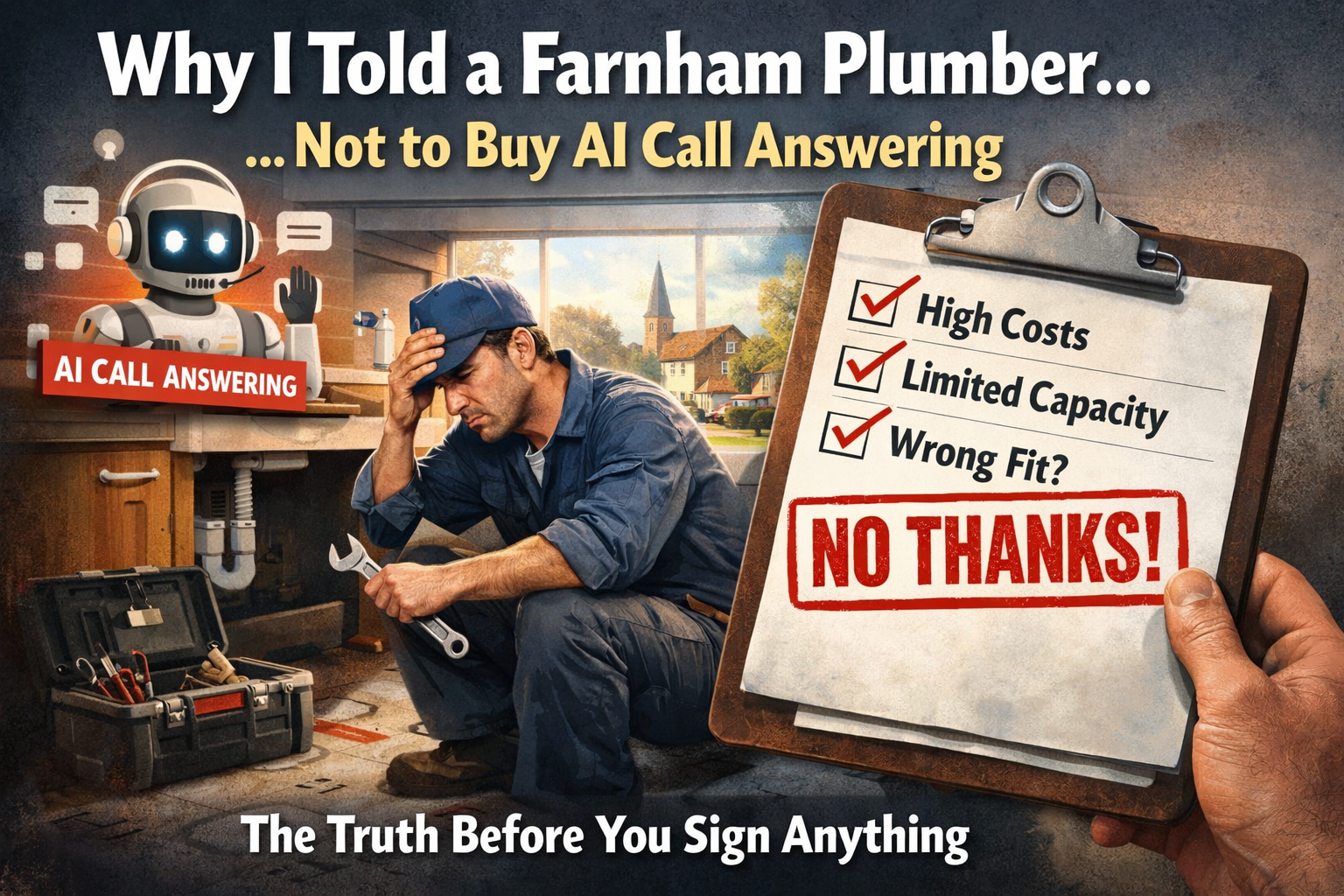
AI call answering sounds perfect for Hampshire and Surrey tradespeople — but it isn't right for everyone. Here's the honest truth before you sign anything.
Why I Told a Farnham Plumber Not to Buy AI Call Answering (And When I'd Tell You the Opposite)
A plumber from Farnham rang me last month. Three employees, booked solid, missing calls while he was knee-deep under someone's kitchen sink. A vendor had told him he was "leaving money on the table" and that AI call answering would fix everything.
I told him not to buy it.
Not because the technology doesn't work — it absolutely does. But because it wasn't the right fit for him, at that point in time, for the reasons that vendor was pitching.
I've spent years implementing these systems for local electricians, plumbers, and vehicle recovery operators across Hampshire and Surrey. I've watched them transform small trade businesses. I've also watched them drain money and create more problems than they solved. And the difference almost always comes down to one thing: whether anyone bothered to ask the right questions before signing up.
Here's what most vendors won't tell you.
The Calculation Vendors Hope You Don't Do
Whenever a Hampshire or Surrey tradesperson with a handful of employees asks me about AI call answering, I don't open with a product demo. I ask one question:
Is there enough unanswered call volume to actually justify this?
There's a statistic that gets thrown around constantly — UK small businesses miss 47% of incoming calls, and 85% of those callers never ring back. Vendors love that number. It's designed to make you panic.
But the real question isn't whether you're missing calls. It's whether capturing them will actually move the dial for your business.
Here's the simple maths I use with every client:
Average job value × conversion rate × missed calls per month = your real ROI
If you're missing one or two calls a day, converting half of them, at £300 a job — even our entry-level package pays for itself with a single booked weekend job. The numbers work immediately.
But if you're only missing a handful of calls each month at a lower job value, the economics look very different. You need to be honest about your conversion rate and your actual missed call frequency — not the scary industry average.
Phone leads from tradespeople convert at 25–40%. That's because someone ringing a plumber is usually dealing with something urgent. The intent is high. The need is real. Web form enquiries convert at around 2% by comparison. So yes, missed calls hurt. But they only hurt as much as your specific numbers suggest.
The Problem Nobody Talks About: What If You're Already Full?
Let's say the maths stacks up. You're missing ten calls a week at £300 average job value. That looks like a straightforward case for AI answering, right?
Not if you're already at capacity.
This comes up more than you'd think with tradespeople across Surrey and Hampshire. They're working 60-hour weeks, they know they can't take on more jobs — and yet something still pulls them toward the idea of capturing every call. It's not irrational. It's ambition. They built their own business because they wanted to grow, and turning away work feels like failure.
But here's what I tell them: if you're maxed out, adding more bookings doesn't grow your business. It creates a backlog that damages your reputation when you can't deliver quickly enough.
What those businesses usually need first isn't more leads. It's time back.
Quotations that eat up evenings. Invoicing that spills into weekends. Customer follow-ups that fall through the cracks. These are the things draining capacity without generating direct revenue. Sorting the workflow often creates more growth potential than any amount of call answering technology.
The right automation for your business right now might not be call answering at all.
When AI Call Answering for Tradespeople Actually Works Brilliantly
That said — when the conditions are right, these systems genuinely transform small trade businesses. The operators I've seen benefit most share a few things in common:
They're in the earlier stages of growth. They're regularly losing calls during working hours because they're on the tools. Their admin systems are relatively simple, which means integration isn't a headache.
For these businesses, AI call answering does something powerful: it lets them focus entirely on delivering great work, without losing the enquiries that come in while they're doing it.
From a practical standpoint, implementation is straightforward. The operator shares credentials for whatever calendar or booking system they use — we handle everything else and typically go live within 24 hours. The system then learns and refines itself over the first few weeks based on real call patterns.
But I'll be honest about something: I turn clients away if I don't think the economics support it. If the call volume isn't there to justify the cost, I say so and suggest we revisit later. That's not how most vendors operate, but I'd rather lose a sale than set a business up to be disappointed.
Will Customers in Hampshire and Surrey Actually Accept It?
This is the question I get asked almost every time. Surrey and Hampshire customers are often relationship-driven. They choose their plumber or electrician based on a recommendation from a neighbour. Does an AI answering system break that personal connection?
In practice, far less than you'd think.
What customers actually want is to feel heard. They want to know their call was registered, that someone (or something) understood their problem, and that something will happen next. If a booking gets made and a confirmation lands in their inbox, most people don't spend long thinking about what took the call.
That said, there's a genuine trust issue that deserves honesty. Research suggests over a third of consumers would lose confidence in a company they felt had hidden AI usage from them — with some describing it as a form of betrayal. The answer to that isn't to avoid AI. It's to implement it well and be transparent about it.
A well-built system that books jobs smoothly, confirms appointments and follows up properly? Customers respond well to that. A clunky bot that misunderstands them and leaves them hanging? That's where the damage gets done.
Quality implementation matters enormously. The technology is only as good as the setup behind it.
Why I Started With Weekend Coverage — Not 24/7 Availability
Most AI answering vendors lead with 24/7 availability as their big sell. I started with something more specific: weekend coverage.
The reason is simple. Most tradespeople started working for themselves because they wanted control over their time. Weekends matter. Family time matters. The freedom to switch off was part of the whole point.
But here's what actually happens on weekends: homeowners make decisions. They're walking around their house noticing problems. They've finally got time to deal with that leaky tap or the quote they've been putting off. They're ready to commit. And the first tradesperson who answers that call usually gets the job — research suggests around 80% of homeowners hire the first electrician or plumber who picks up.
Weekend AI call answering isn't about grinding through your days off. It's about protecting your personal time while making sure the high-intent customers who call on a Saturday morning don't ring your competitor instead.
That's a completely different proposition to "be available every hour or lose business." It's about choosing when your business works for you — and making those moments count.
The Gap Between What Vendors Promise and What Actually Happens
It's worth being clear-eyed about this industry. Studies suggest 70–85% of AI initiatives fail to meet expected outcomes. The most common reason isn't that the technology is bad. It's that businesses try to bolt new tools onto old ways of working without changing anything about how they operate.
For small trade businesses in Hampshire and Surrey, this often plays out in a specific way: the system gets set up, but the workflow around it never adapts. Calls get answered, but nobody's clear on how to follow up. Bookings get made, but they land in a system nobody's checking.
The way I avoid this is by handling the operational side ourselves. The client gives us what we need, we build the integration, and we stay involved through the early weeks as the system matures. It's not perfect for every business — but it dramatically reduces the implementation failures I see other vendors dealing with.
The Most Common Mistake Hampshire and Surrey Tradespeople Make
When I look back across the businesses I've worked with, the most common mistake isn't jumping in too fast.
It's waiting too long for the wrong reasons.
Fear about how customers will react. Uncertainty about whether it'll work with their current setup. A vague feeling that it's probably not for them just yet. Meanwhile, every missed call is a potential job that went to a competitor.
UK businesses are estimated to lose around £30 billion collectively each year to missed calls. For an individual trade business, that figure is roughly £5,500 annually. Those numbers aren't designed to scare you into buying something — they're a reminder that inaction has a cost too.
But the right response to that isn't to rush into a purchase that doesn't fit your situation. It's to do the diagnostic work first. Understand your actual missed call volume. Be honest about your capacity. Run the maths on your average job value and conversion rate.
If the answer points toward AI call answering, implement it quickly — delay genuinely costs money.
If the answer points somewhere else first, follow it there. Get the workflow right, free up some capacity, and revisit in three months.
That's the framework. It's not as exciting as a vendor pitch, but it's what actually works for small trade businesses in Hampshire and Surrey trying to grow without losing the life they built the business to protect.
Looking for AI call answering that actually fits your trade business in Hampshire or Surrey? Start with a conversation, not a contract.
